
Bottled water delivery, or filtered water from your tap?
An honest comparison of the two ways to get better drinking water at home in Barcelona — what each costs, what each takes up, and when delivery is genuinely the better choice.
 Get in touch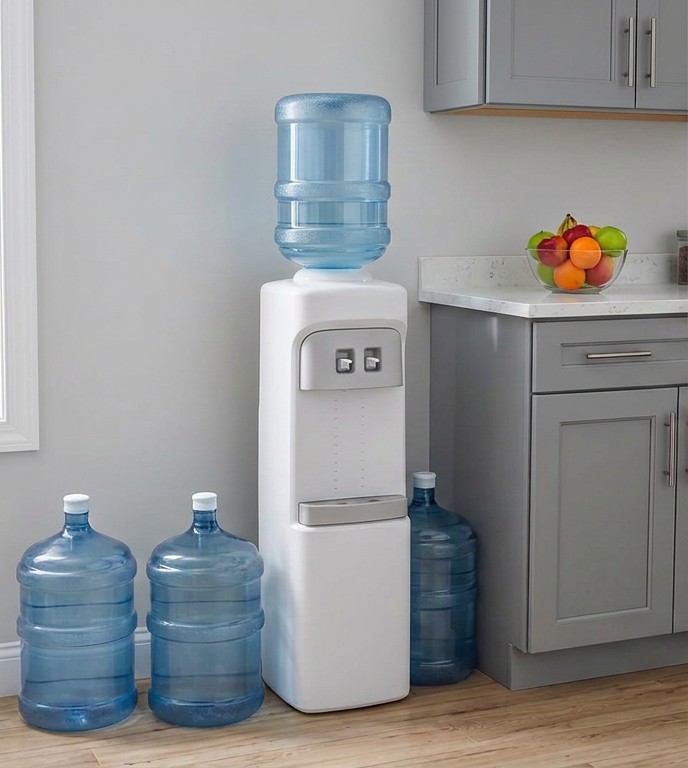
Delivery
Oasly
Delivery service vs. filtration at the tap
The difference is architecture: water that is stored and transported, versus water that is filtered on demand where you drink it. Here is how the two compare, row by row.
Where the water comes from
Delivery
Purified and bottled at a plant, then transported to your door
Oasly
Your own mains supply, filtered at the point of use
Freshness
Delivery
Sits in a plastic bottle at room temperature, typically a month between deliveries
Oasly
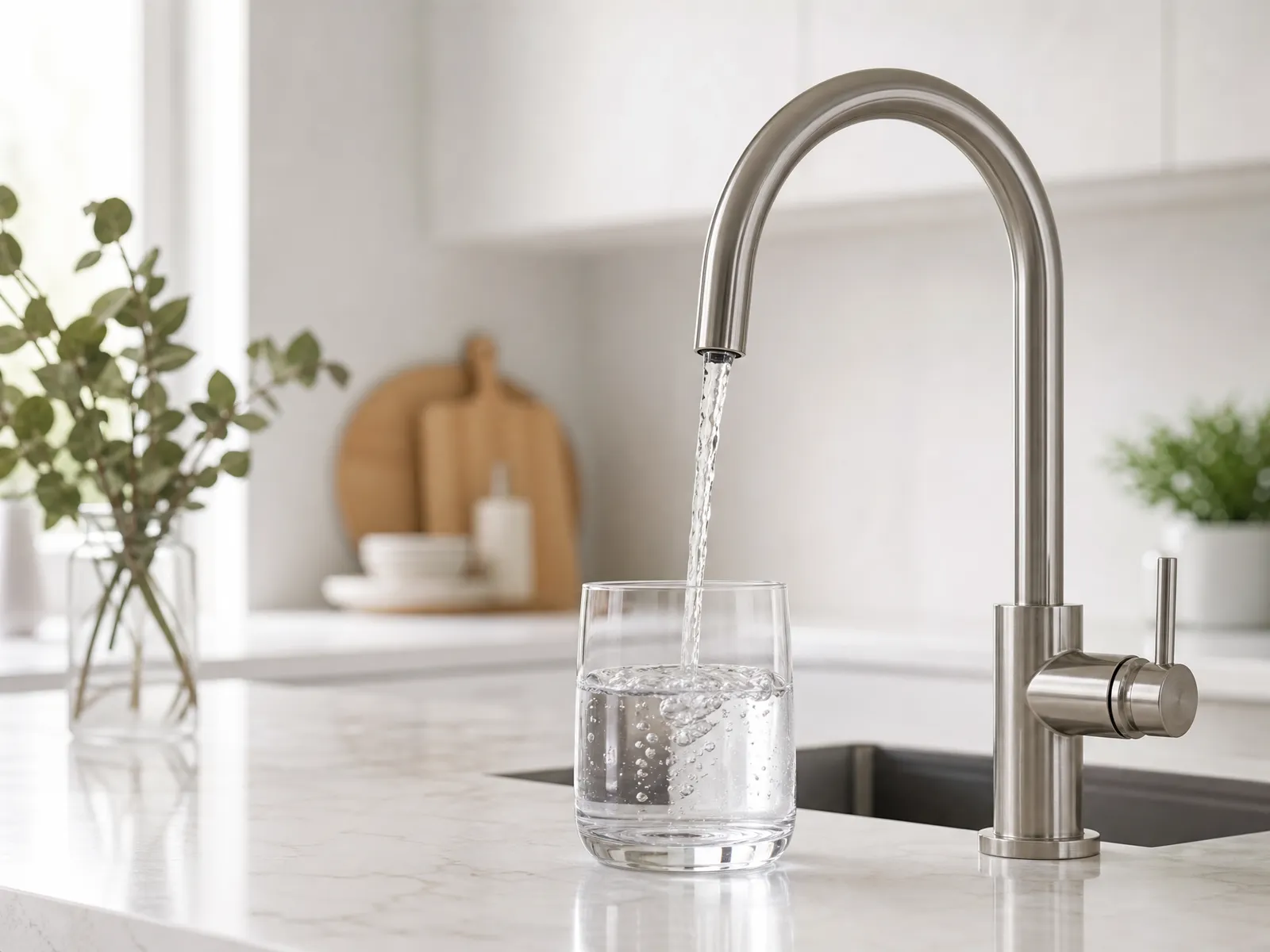
Filtered the moment you open the tap — nothing is stored
Can you run out?
Delivery
Yes, between delivery cycles
Oasly
No
Floor space
Delivery
A dispenser, plus somewhere to keep full and empty bottles
Oasly
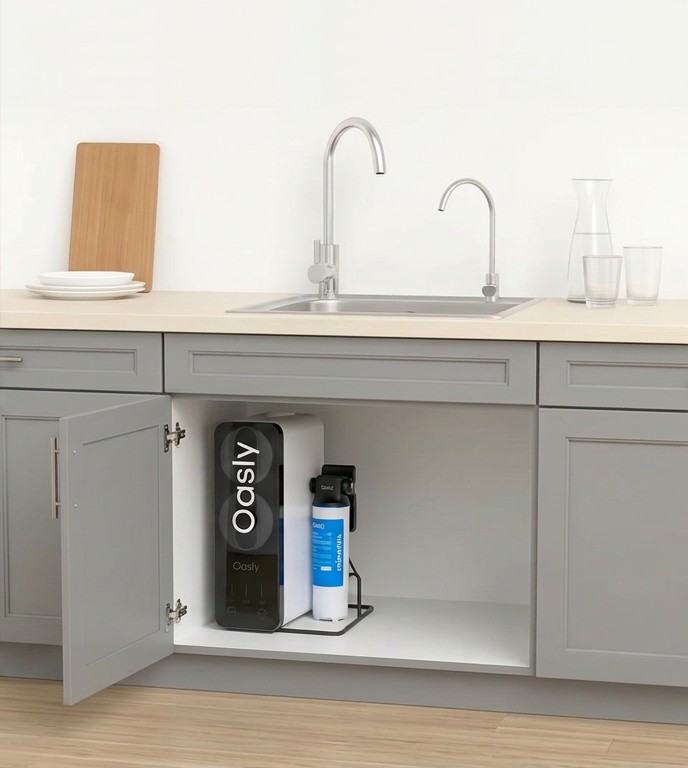
Under the sink. Nothing on the floor
Physical handling
Delivery
Lifting and inverting a 20 kg bottle each cycle
Oasly
None
Electricity
Delivery
Dispensers heat and cool continuously. Spanish consumer organisation OCU measured units of this type drawing roughly twice as much as a fridge (OCU, June 2025)
Oasly
About 85 W, and only while producing water
Minerals and taste
Delivery
Varies by product
Oasly
Remineralised with calcium, magnesium and potassium so it does not taste flat; slightly alkaline
Price transparency
Delivery
Typically quoted after a sales visit rather than published
Oasly
Published: €24.90/month or €249/year in Barcelona city, €27.90/month or €279/year in the extended area, or €629–€699 to buy
Commitment
Delivery
Varies by provider
Oasly
No minimum term · two months' written notice
| Criterion | Water delivery service | Oasly |
|---|---|---|
| Where the water comes from | Purified and bottled at a plant, then transported to your door | Your own mains supply, filtered at the point of use |
| Freshness | Sits in a plastic bottle at room temperature, typically a month between deliveries | Filtered the moment you open the tap — nothing is stored |
| Can you run out? | Yes, between delivery cycles | No |
| Floor space | A dispenser, plus somewhere to keep full and empty bottles | Under the sink. Nothing on the floor |
| Physical handling | Lifting and inverting a 20 kg bottle each cycle | None |
| Electricity | Dispensers heat and cool continuously. Spanish consumer organisation OCU measured units of this type drawing roughly twice as much as a fridge (OCU, June 2025) | About 85 W, and only while producing water |
| Minerals and taste | Varies by product | Remineralised with calcium, magnesium and potassium so it does not taste flat; slightly alkaline |
| Price transparency | Typically quoted after a sales visit rather than published | Published: €24.90/month or €249/year in Barcelona city, €27.90/month or €279/year in the extended area, or €629–€699 to buy |
| Commitment | Varies by provider | No minimum term · two months' written notice |
Delivery-service figures describe the category in general; terms vary by provider. We measure your TDS before and after installation and show you both numbers.
Common questions about the two options
When is a bottled water delivery service the better choice?
If you can't drill a hole for a second tap and your landlord won't allow a 3-way faucet; if there's no cold water connection near where you want to drink; if you want 90 °C water on tap without boiling a kettle; or if you're outside Barcelona, where we don't install. If any of those describe you, a delivery service is probably the better fit. We'd rather tell you now.
Is bottled water delivery or a filter cheaper?
It depends on how much you drink and on the quote you are given. Delivery pricing is usually arranged after a sales visit rather than published, so compare the total yearly figure. Our prices are published: €24.90 per month, €249 per year, or €629 to €699 to buy the unit outright.
How much space does a water dispenser take up?
A floor-standing dispenser occupies roughly the footprint of a small bin, and you also need somewhere to keep full bottles waiting to be used and empty ones waiting for collection. A point-of-use filter sits inside the sink cabinet instead, so nothing stands on the kitchen floor.
Do water dispensers use a lot of electricity?
They heat and cool water continuously, so they draw power around the clock. Spanish consumer organisation OCU measured units of this type drawing roughly twice as much as a fridge (OCU, June 2025). Our system uses about 85 W, and only while it is actually producing water.
What happens if I run out of bottled water?
You wait for the next delivery cycle, or you buy bottles at the supermarket to bridge the gap. Deliveries are typically monthly, so a heavier week can leave you short. Water filtered at the tap draws from your mains supply, so there is no cycle to run out of.
Can I install a water filter in a rented flat in Barcelona?
Often yes, but ask your landlord first. Installation means connecting to the cold-water feed and drain under the sink, and usually a dedicated faucet, which needs a hole in the worktop or sink. If drilling is not allowed, a delivery service is likely the better option for you.
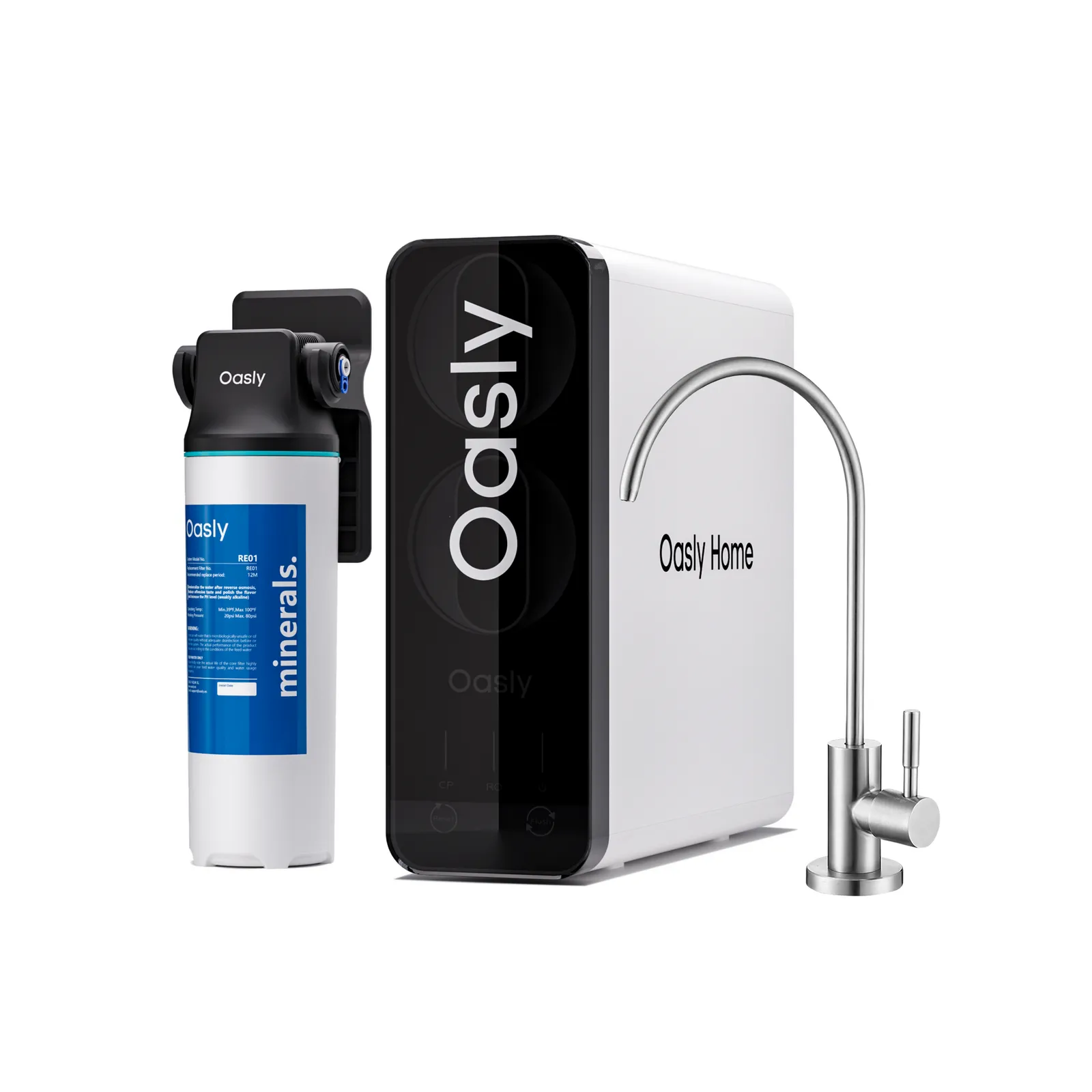
Oasly Home
Limitless Hydration
Filtered, remineralised water. Straight from your tap.
Key specifications
- Capacity
- 600 GPD
- up to 2,270 litres a day
- Output speed
- 10 seconds
- to fill a 330 ml glass
- Filtration
- 7 stages
- across 3 cartridges
- Drain ratio
- 2:1
- roughly 6× less water to drain than a 1:3 system
- Measured output
- Before and after
- we measure TDS in your kitchen and show you both readings
- Service
- Free installation
- and service in Barcelona
- Capacity
- 600 GPD
- up to 2,270 litres a day
- Output speed
- 10 seconds
- to fill a 330 ml glass
- Filtration
- 7 stages
- across 3 cartridges
- Drain ratio
- 2:1
- roughly 6× less water to drain than a 1:3 system
- Measured output
- Before and after
- we measure TDS in your kitchen and show you both readings
- Service
- Free installation
- and service in Barcelona
Direct flow. No tank.
to fill a 330 ml glass
2,270 litres a day
600 GPD rated membrane
2:1 filtered to drain
roughly 6× less waste than a 1:3 system
How reverse osmosis works
Reverse osmosis is the same process used to bottle drinking water and to turn seawater into fresh water. It separates by scale.
An RO membrane is not a sieve with holes. It is a dense polymer film, rated at approximately 0.0001 micron. Water molecules cross it readily. Dissolved salts, metals and larger molecules cross far less readily — they are both physically larger and chemically less able to pass through the film.
Three cartridges. Seven stages.
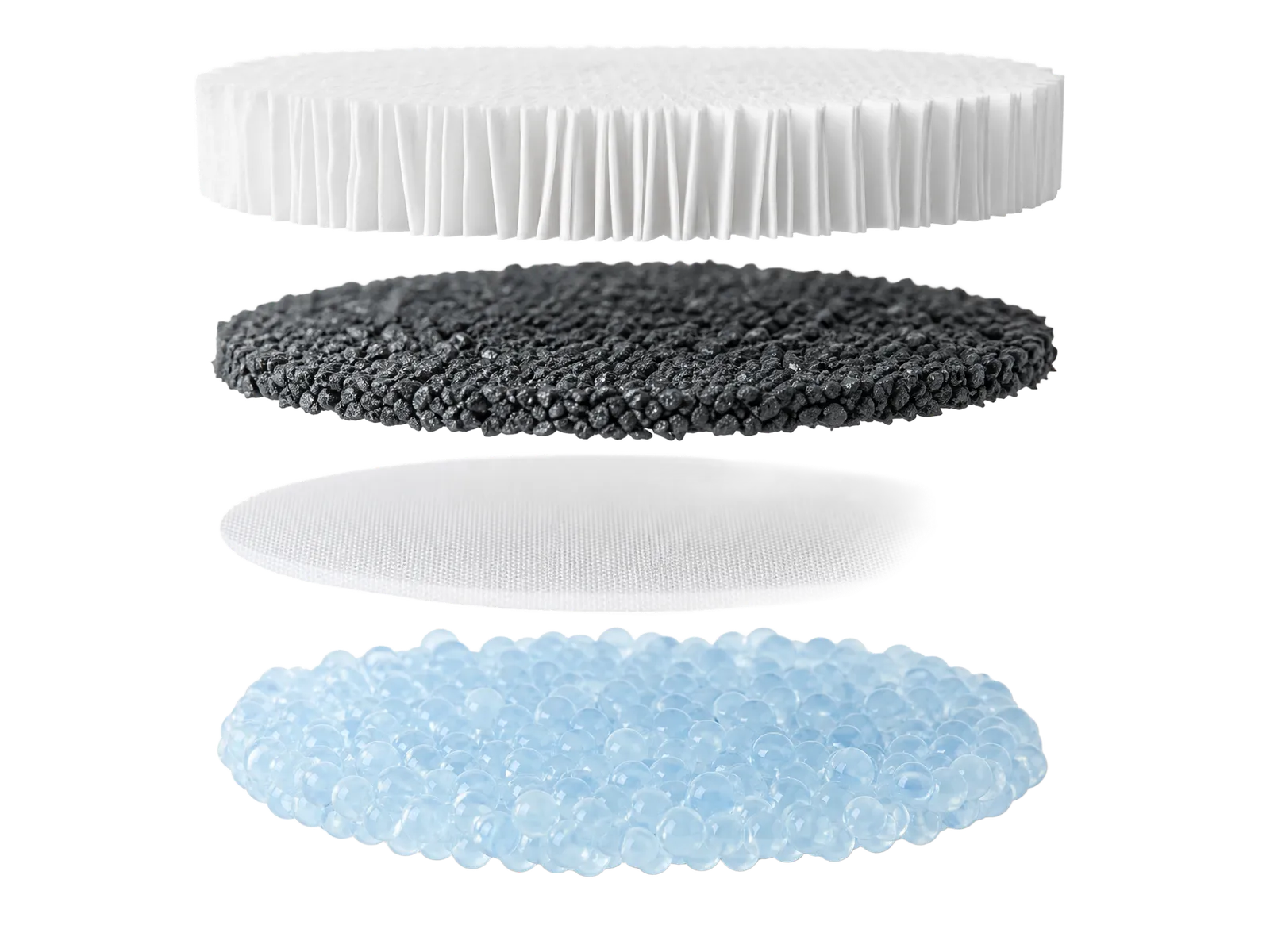
Illustrative. Filter media are housed inside sealed cartridges.
Tap water in ↓
Composite pre-filter
Sediment and carbon
Stages 1–3 · every 12 months
- 1Pleated sediment layerRust, sand and silt down to 5 µm
- 2Activated carbon blockChlorine, chloramine, taste and odour
- 3Carbon compound layerVOCs, trihalomethanes and organic residues
Reverse osmosis membrane
600 GPD
Stage 4 · every 24 months
- 4Reverse osmosis membraneA semi-permeable membrane with a pore size of 0.0001 micron — filters dissolved solids by size
Remineralization filter
Alkaline and minerals
Stages 5–7 · every 12 months
- 5Alkaline mediaLeaves the water slightly alkaline
- 6Mineral restorationAdds calcium, magnesium and potassium
- 7Post-carbon polishFinal taste polish before the tap
Filtered, remineralised water out ↓
Stage counts describe the filtration layers inside each cartridge. Replacement intervals assume typical Barcelona mains water and normal household use.

A 0.0001 micron scale
- Human hair70 µm
- Cysts such as Giardia and Cryptosporidium3–15 µm
- Microplastic fragments0.5–5 µm
- Dissolved salts and metal ionsaround 0.001 µm
- RO membrane rating0.0001 µm
This is why reverse osmosis is used in applications where water purity matters most.
Particle sizes above are typical published ranges for reference. How much any individual system reduces a given substance depends on the unit, the incoming water and the age of the membrane. Further independent testing on our own unit is in progress with an ENAC-accredited Spanish laboratory, and we'd rather publish those numbers than estimate.
What we actually measure
We measure the total dissolved solids in your tap water before installation, and again from the new tap afterwards. You see both numbers, taken in your own kitchen. Part of the finished-water reading is the calcium and magnesium the remineralisation filter adds back.
Substance-by-substance reduction figures come from SGS test report NBF25-0016876-01, tested to the NSF/ANSI 58-2023 challenge protocol, except chlorine (NSF/ANSI 42-2023) and total coliforms (independent SGS testing). Rates were measured with a new membrane; real-world performance declines as the filter ages. Further independent testing with an ENAC-accredited Spanish laboratory is in progress.
What we remove
Heavy metals
- Lead
- 99.8%
- Arsenic
- 99.9%
- Chromium VI
- 99.6%
- Cadmium
- 99.6%
- Copper
- 99.3%
- Mercury
- 97.1%
- Barium
- 99.7%
- Selenium
- 97.1%
Chemicals
- PFAS — PFOS
- 99.6%
- PFAS — PFOA
- 99.4%
- ChlorineNSF/ANSI 42-2023
- 99.5%
- Chloramine
- Perchlorate
- 98.1%
Microorganisms
- Bacteria, total coliformsIndependent SGS testing, not an NSF/ANSI protocol
- 99.99%
- Cysts (Giardia, Cryptosporidium)
Particles
- Microplastics
- Turbidity
- 97.7%
- Sediment & rust
Other
- Total dissolved solids
- 94–95%
- Nitrates
- 96.8%
- Fluoride
- 94.7%
Reduction rates from SGS test report NBF25-0016876-01 (9 September 2025). Unless a row says otherwise, figures were tested to the NSF/ANSI 58-2023 challenge protocol; chlorine was tested to NSF/ANSI 42-2023, and total coliforms under an independent SGS protocol for reverse osmosis devices rather than an NSF/ANSI one. Rates were measured with a new membrane; real-world performance declines as the filter ages. Actual results vary with source water quality, pressure, temperature and filter age. We measure your TDS before and after installation.
Alkaline adjustment
RO water on its own — near-zero minerals
Oasly Home output — slightly alkaline, minerals restored
Reverse osmosis leaves very low-mineral water, and you taste it: it comes across as flat. The remineralization filter adds calcium, magnesium and potassium back, which is what gives the water its taste again.
Ca²⁺
Calcium
Mg²⁺
Magnesium
K⁺
Potassium
Ionically activated minerals released by the remineralization cartridge, replaced once a year.
If you test it yourself
Straight out of the membrane, the water carries almost no minerals. The remineralization filter then adds calcium, magnesium and potassium back, so a TDS pen reads higher.
That higher number is the minerals we add back. It is what you want to see.
Exact readings vary with incoming mains water and how recently the remineralization cartridge was replaced.
Why Choose Oasly
Minerals
Reverse osmosis with remineralisation — calcium, magnesium and potassium added back, so the water is slightly alkaline and does not taste flat.
Taste
Activated carbon stages address chlorine taste and odour for smooth drinking.
Convenience
Unlimited water on demand, fills a glass in just 10 seconds. No more carrying heavy bottles.
Eco-Friendly
No plastic bottles, and a 2:1 filtered-to-drain ratio — roughly 6× less water sent to the drain than a conventional 1:3 system.
Cost-Effective
Just €0.68–0.83 per day for unlimited water, with no bottles to buy or carry.
Looked after
We handle installation, filter changes and servicing. You just drink the water.
Oasly Home vs. tank system
Under-sink footprint
Water sent to drain
Water storage
Plumbing
Filter removal
Filter changes
Comparison figures for conventional systems are typical market values and vary by model.
We keep track of it for you
Filter changes, scheduled
We track the life of every filter and get in touch when one is due. You don't need to remember, monitor anything, or work out which cartridge it is.
Upgrades included
If we improve the system, subscribers get the upgrade at no extra cost.
A real person, on WhatsApp
Something not right? Message us and a technician answers — no ticket queue, no call centre.
Will it fit under your sink?
At least 45 × 45 × 45 cm clear. The Oasly Home measures 400 mm high, 380 mm deep, 140 mm wide, plus the remineralization filter beside it.
An earthed outlet under or near the sink. The system draws about 85 W only while it is producing water.
A standard kitchen shut-off valve on the cold supply. Mains pressure 1.4–5.5 bar, water temperature 4–38 °C. No extra plumbing work is needed in almost every Barcelona kitchen.
A saddle clamp fits onto the existing sink waste pipe. Nothing is cut or replaced.
The standard Oasly faucet needs a 1.3 cm hole in the worktop. The 3-way faucet replaces your existing mixer tap.
Send a photo of your under-sink cabinet on WhatsApp. We confirm before you book.
Message us on WhatsApp →Faucet options
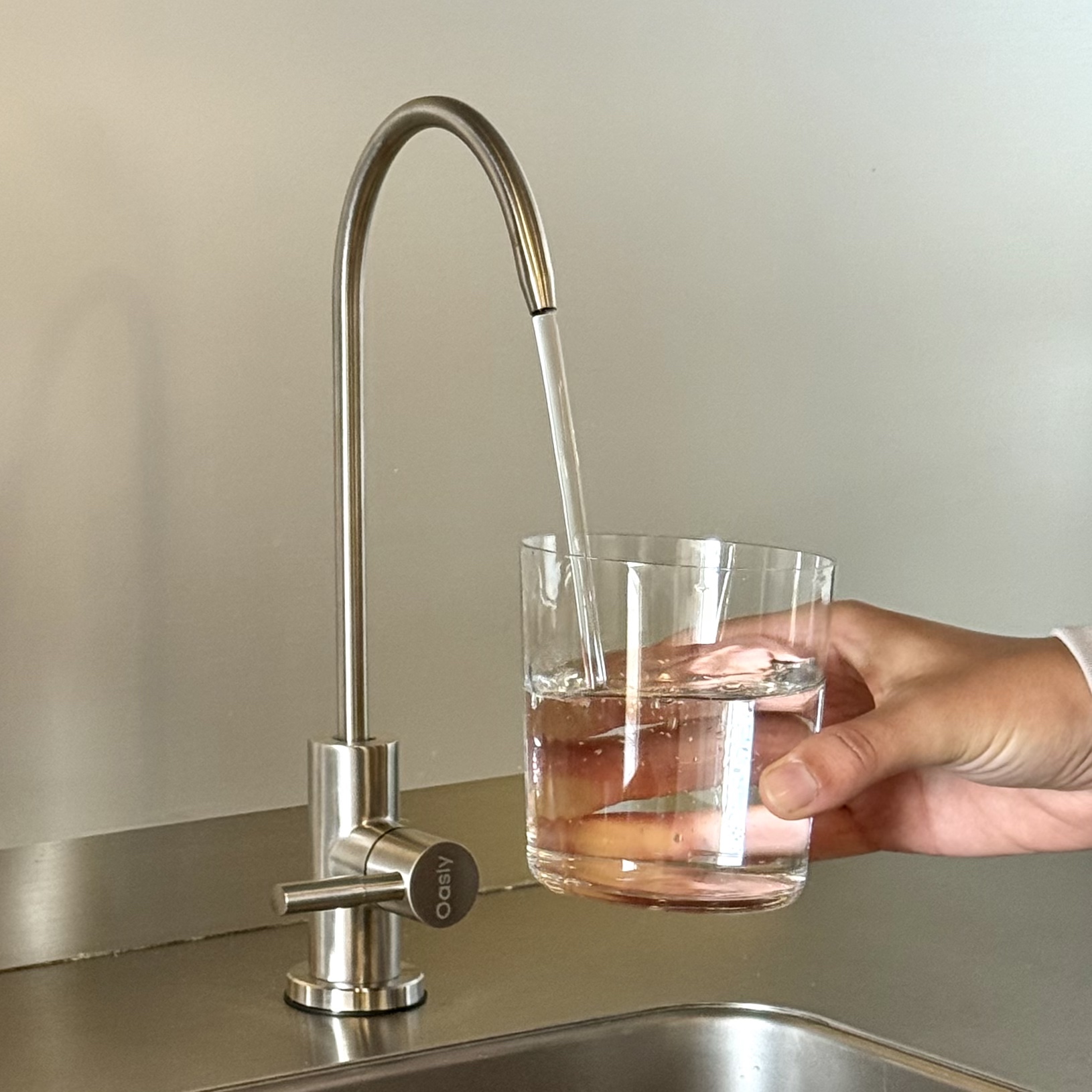
Standard Oasly faucet
Included freeRequires drilling a ~1.3 cm hole in the countertop
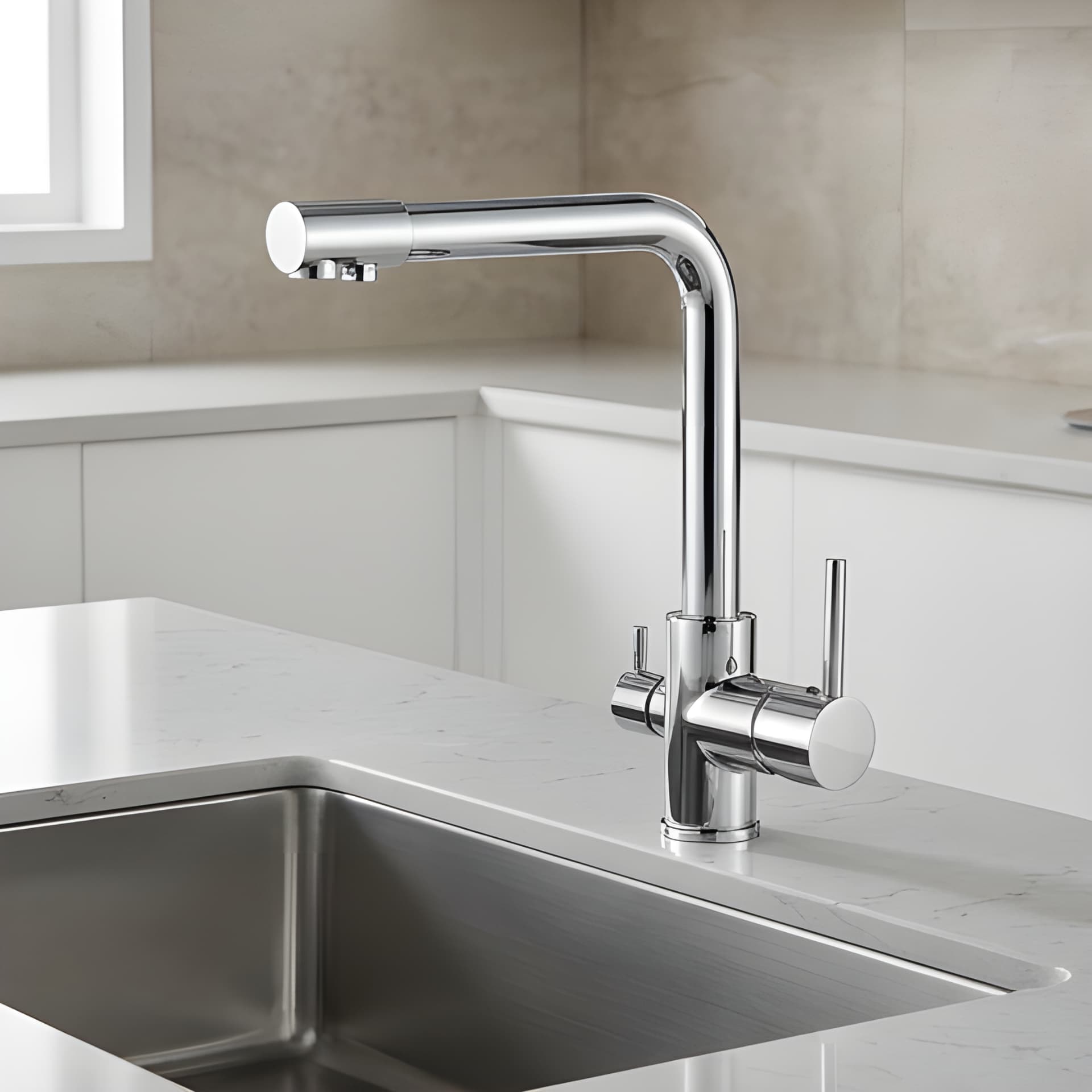
3-way faucet upgrade
€79.90 add-onReplaces your existing tap, delivering both filtered and regular water
Yours to keepChoose Your Plan
Monthly Subscription
€0.83/day in Barcelona city (postcodes 08001–08042)
Extended area (Esplugues, Badalona, L'Hospitalet de Llobregat and Sant Cugat del Vallès): €27.90/month
- Installation: Included
- Filter Changes: Included
- Maintenance: Included
- Relocation in BCN: Included
- Deposit: None
Yearly Subscription
Barcelona city (postcodes 08001–08042)
Extended area (Esplugues, Badalona, L'Hospitalet de Llobregat and Sant Cugat del Vallès): €279/year
- Installation: Included
- Filter Changes: Included
- Maintenance: Included
- Relocation in BCN: Included
- Deposit: None
One-Time Purchase
or €699 with installation in Barcelona
- Installation: €699 with installation in Barcelona
- Filter Changes: Customer purchases
- Maintenance: Customer responsibility
- Relocation in BCN: Not included
- Deposit: None
- Ownership: Customer owns
Subscriptions include the unit, installation, the annual filter change, maintenance and service, and free relocation if you move within the service area. No deposit and no upfront cost on any plan. No minimum term, with two months' written notice.
Warranty & Service
On subscription: service included
Installation, every filter change, servicing, leak checks and relocation within Barcelona are all included for as long as you subscribe. No call-out fees, no parts to buy.
On purchase: 3-year EU statutory warranty
Buy the system outright and it carries the standard Spanish and EU conformity guarantee — three years from delivery, covering manufacturing defects and system performance.
The detail, if you want it
Cost comparison · 5-year overview
Monthly, yearly or buy outright — what each option really costs you after 1, 2, 3, 4 and 5 years.
View →Frequently Asked Questions
Product & Technology
Water Quality & Measurement
Installation & Requirements
Subscription & Pricing
Maintenance & Support
Service Area & Logistics
Health & Safety
Environmental Impact
Comparisons
Technical Troubleshooting
About Oasly
- Main website: https://www.oasly.es
- Online shop: https://oasly.shop
- Product details: https://product.oasly.es